
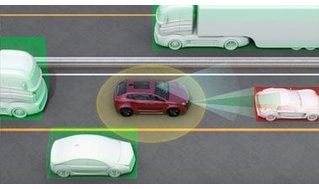
In this course, we will introduce you to the fundamentals of sensor fusion for automotive systems. Key concepts involve Bayesian statistics and how to recursively estimate parameters of interest using a range of different sensors.
The course is designed for students who seek to gain a solid understanding of Bayesian statistics and how to use it to fuse information from different sensors. We emphasize object positioning problems, but the studied techniques are applicable much more generally. The course contains a series of videos, quizzes and hand-on assignments where you get to implement many of the key techniques and build your own sensor fusion toolbox.
The course is self-contained, but we highly recommend that you also take the course ChM015x: Multi-target Tracking for Automotive Systems. Together, these courses give you an excellent foundation to tackle advanced problems related to perceiving the traffic situation around an autonomous vehicle using observations from a variety of different sensors, such as, radar, lidar and camera.