
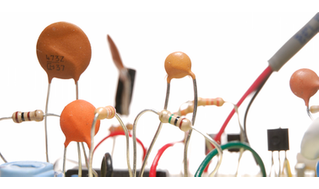
We start from the very beginning in electronics. What is voltage? What does it physically mean? What is current? What happens in a circuit and how can things like power consumption be calculated?
In this course we learn how to analyze circuits through a variety of methods, including the Kirchoff voltage and current laws, superposition, Node Voltage Analysis, Thevenin’s Theorem and concepts such as impedance matching and maximum power transfer. These are useful to predict the performance of circuits.
We look at various types of equipment used for electrical circuit measurements, including power supplies, multimeters, oscilloscopes, and function generators. At the end of the course, students will be able to use resistors, capacitors, inductors, diodes, and batteries in circuits as well as analyse and design circuits containing these components. One of the circuits built in the course is a light sensing circuit.