
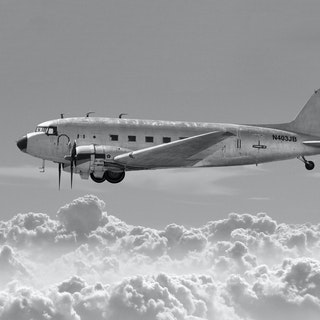
More than one century after the Wright brothers’ first flight, the flight still defy our intuition. You will learn here how to name the different parts of the airplane and how to describe and quantify its geometry. For that, we need now to share a precise vocabulary to describe the airplane’s movement and attitude in space, and a refresher on basic general mechanic principles. You will remind how Newton’s 2nd law allows you to determine what force must be applied on an apple – or on an airplane, to modify the magnitude and direction of its speed. Coming back on the concepts of kinetic energy and potential energy, you will discover the very useful concept of total height and you will be able to explain how an airplane can quickly exchange speed for altitude, while changes in total height are much slower.
In the end, you will discover that only a very small number of forces apply on an airplane in flight and that you will be able to classify those that change its energy state and those that modify its trajectory. You will discover the concept of load factor and understand why the pilot of a combat aircraft can feel a weight nine-time greater than his actual weight! Finally, we will establish the lift and propulsion equations, that form the basis of flight mechanics, and you will be able to compute the lift and thrust necessary to follow a given trajectory at a given speed.
This course is for anybody interested in learning more about how planes work, the physics of flying, or flight mechanics. It will be of particular interest to undergraduate students in aerospace engineering, trainees as well as senior pilots, journalists, and professionals in the aeronautics sector.
Although some mathematical formalism may be present sometimes. It is always doubled by sketches, figures, and hands-explanations. So that, anybody can skip the formulas without losing the core understanding of the concepts.
No apples were harmed in the making of this course…
This course is only a foretaste of the mechanics of flight. ISAE-SUPAERO and Eric Poquillon will offer you other courses and the first specialization in autumn 2021. Initially, three courses will be published to answer several questions: Can we fly as high as we want? What is a stall? Why do some planes have propellers and others have jet engines? Is an airplane always stable? How do you control an airplane following an engine failure? All this and more will be covered in this series of flight mechanics courses.
This course is a part of the specialization “Fundamentals of Flight mechanics”.